
 Property
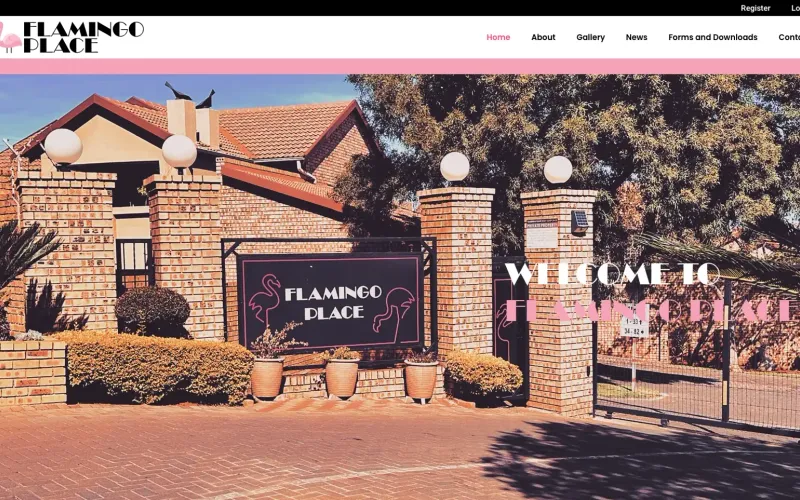
 Flamingo Place
Luxury residential complex in The Wilds Estate, Pretoria - a contemporary, upscale gated community.
flamingoplace.co.za
Every estate website ends up doing two jobs: presenting the place to prospective residents, and saving the trustees from emailing the same levy form to a hundred households every quarter.
A prospective buyer or tenant wants photographs, location, what the place is like to live in. A current resident wants the rules, the levy schedule, the minutes, the notice about the water being off on Thursday. Neither should have to wade through the other's content.
We built Flamingo Place in The Wilds Estate, Pretoria with a public site carrying the gallery and the estate information, and a register-and-login layer holding a forms and downloads library plus estate news. One site, two clean paths.
Estate paperwork routinely contains personal information - unit numbers against names, contact lists, account details, sometimes access records. A public downloads folder containing any of that is a compliance problem waiting to be noticed.
A login is the simplest correct answer. It also stops estate documents turning up in Google results, which is a conversation no trustee wants to have at an AGM.
The person who commissions an estate website is usually a volunteer trustee who will hand over in a year or two. Sites built around one enthusiastic individual tend to go stale the moment that person steps down.
So we build for handover: simple enough that a non-technical trustee can post a notice without help, documented, and with the hosting and domain held in the body corporate's name rather than anyone's personal account. That last point causes more trouble than any technical decision.
A live site you can open and judge for yourself.
Yes - that is the core of it. Flamingo Place has exactly this: residents register, log in, and get a forms and downloads library plus estate news that is not visible to the public web.
The body corporate, always - never a trustee's personal account. It is the single most common problem we inherit, and it becomes painful the moment that person moves out or falls out with the committee.
Yes. We build these to be posted to without help, and hand over written instructions. If you would rather not think about it at all, a care plan covers the updates.
A public site with a resident portal is quoted per project, because the portal side varies a lot. The public-facing part alone usually fits the R5 000 or R8 000 builds.
Tell us about your project and get a free, no-obligation quote within 24 hours.