
Why Is My Website Not Showing on Google? (South African Guide)
Your website exists but nobody can find it on Google. Here are the real reasons South African businesses stay invisible in search, and how to fix each one.
R Ryan Heinrich Founder & lead developer
It’s one of the most frustrating messages we get: “We paid for a website, it’s been live for months, and we still don’t show up on Google.” Almost every time, the cause is one of a handful of specific, fixable problems. Here’s how to work through them in the order that actually matters.
First: are you invisible, or just ranking low?
These are different problems with different fixes, so check which one you have before doing anything else.
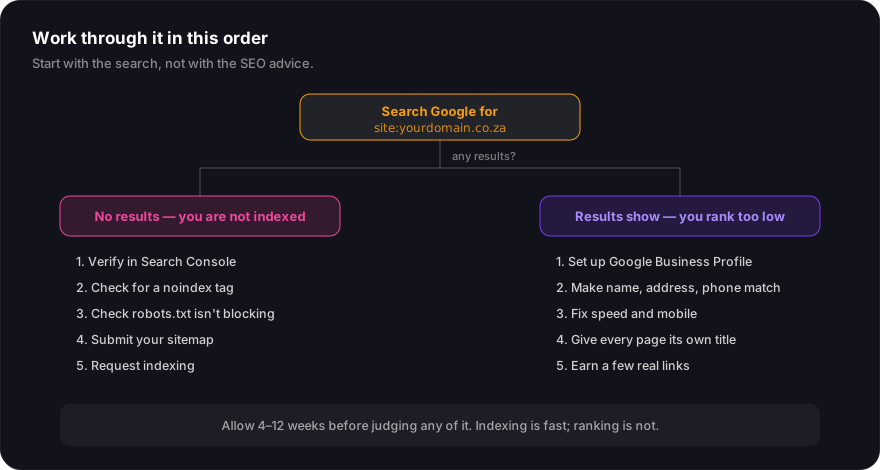
Search Google for site:yourdomain.co.za (using your actual domain). If pages come back,
Google has indexed your site and you’re competing but ranking too low. If you get nothing,
Google doesn’t know your site exists at all, which is a much more fundamental issue.
Then search for your exact business name. If you don’t appear for your own name, something is seriously wrong, because that’s the easiest term you’ll ever rank for.
If Google hasn’t indexed you at all
Your site was never submitted to Search Console
Google finds most sites eventually, but “eventually” can mean months. Google Search Console is free, and submitting your sitemap tells Google your site exists today rather than whenever it stumbles across you. This is the single highest-impact thing most business owners have never done.
A noindex tag is still switched on
This is the one that catches people out most often. Developers frequently add a noindex
tag while building a site to keep the unfinished version out of search results, then forget
to remove it at launch. The site looks perfect to visitors and is completely invisible to
Google. If you’re on WordPress, check Settings > Reading for a tick box labelled
“Discourage search engines from indexing this site.”
robots.txt is blocking the crawler
A misconfigured robots.txt file can tell Google to stay away from your entire site. You can
view yours at yourdomain.co.za/robots.txt. If you see Disallow: / sitting under
User-agent: *, that’s blocking everything.
If you’re indexed but ranking nowhere
You have no Google Business Profile
For any business serving a local area, this is the biggest single lever. Without a claimed and completed profile you simply cannot appear in the map pack, which is the block of three local businesses that sits above the normal results for searches like “web designer Pretoria”. A profile that’s claimed but half-finished, with no photos, no hours and no categories, gets treated as low priority.
Two things worth knowing: don’t stuff your location into your business name (using “ABC Plumbing Johannesburg” when you’re registered as “ABC Plumbing” violates Google’s guidelines and can get you suspended), and keep reviews coming in steadily. A business with 40 recent reviews will generally outrank one with 12 reviews from four years ago and no replies.
Your business details don’t match across the web
Google cross-references your name, address and phone number wherever it finds them. Small
inconsistencies matter more than people expect: “Street” versus “St”, or 082 123 4567
versus +27 82 123 4567. When the details don’t line up, Google can’t confidently tell
whether it’s looking at one business or several, and your ranking signals get split instead
of concentrated. Pick one exact format and use it everywhere, including your website,
Facebook page, and any directory listings.
Your site is slow or awkward on a phone
Google indexes the mobile version of your site first, and well over half of South African traffic is mobile. If your site is difficult to use on a phone, that’s the version being judged. Speed compounds the problem, since visitors leaving quickly is itself a negative signal. We covered this in why a fast website wins more business.
Every page has the same title, or no title
Each page needs its own title and meta description, and one clear H1 that says what the page is about. A surprising number of template-built sites ship with every page titled “Home” and no descriptions at all, which gives Google almost nothing to work with.
Nobody links to you
Backlinks remain one of the strongest ranking factors. A brand new site with zero links pointing at it will struggle against an established competitor with even a handful. Local directories, your industry association, suppliers, and any client happy to credit you are all reasonable starting points.
Be realistic about timing
SEO is slow, and anyone promising first-page results in two weeks is either misleading you or planning something that will cause problems later. For most South African businesses, consistent work on the fundamentals starts showing movement in local results within about two to four months. Competitive national terms take considerably longer.
The order to work through it
- Confirm whether you’re indexed with a
site:search - Set up Google Search Console and submit your sitemap
- Check for a stray
noindextag and yourrobots.txt - Claim and fully complete your Google Business Profile
- Make your name, address and phone number identical everywhere
- Fix mobile usability and page speed
- Give every page a unique title, description and H1
- Start earning a few genuine backlinks
Most businesses find their problem in the first four steps.
If you’ve worked through this and you’re still invisible, the issue is usually structural rather than something a plugin can fix. Get in touch and we’ll take an honest look at what’s holding your site back, whether or not that turns into a project with us.
Where to next
Written by Ryan Heinrich
Founder & lead developer, Fusion By Design
Ryan is the founder of Fusion By Design and has spent 14+ years designing and building websites for South African businesses - from single-page trade sites to directory platforms. He does the design and the development himself, which is why you deal with the person who builds your site rather than an account manager.