
How Long Does It Take to Build a Website? An Honest Timeline
Realistic website build times by project type, what happens in each phase, whether an agency can commit to a launch date, and what delays most projects.
R Ryan Heinrich Founder & lead developer
“How long will it take?” is the second question we get asked, right after what it costs. The honest answer for a typical business website is four to eight weeks, but that number is close to meaningless without knowing what actually happens in that time and what makes it stretch.
Realistic timelines by project type
| Project | Typical timeline |
|---|---|
| One-page or starter site (up to 3 pages) | 1 to 2 weeks |
| Portfolio site | 2 to 3 weeks |
| Local business or trade site | 2 to 4 weeks |
| Standard business website (5 to 10 pages) | 4 to 6 weeks |
| B2B site with several service pages | 5 to 8 weeks |
| Larger site with blog, portfolio, integrations | 6 to 10 weeks |
| E-commerce store | 8 to 12 weeks |
| Custom platform or directory | Quoted per project |
These website build times assume a responsive client and content that is ready or being written in parallel. They are not worst-case numbers, and they are not marketing numbers either - they are what our projects actually take.
What’s actually happening during those weeks
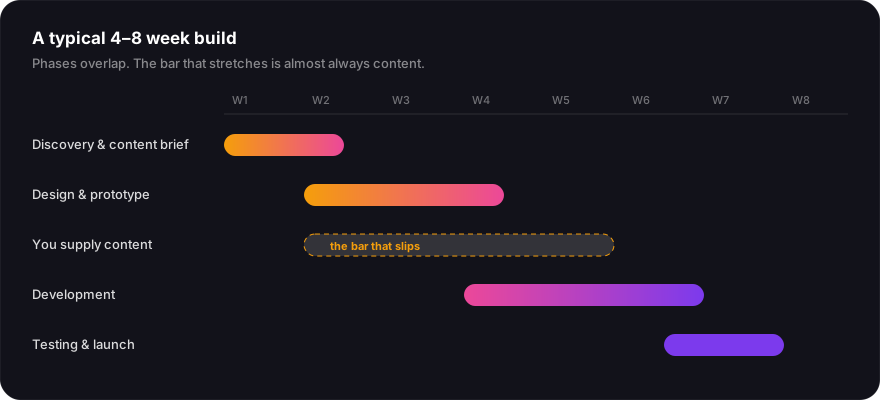
Discovery (2 to 4 days). Understanding your business, your customers, your competitors, and what the site actually needs to achieve. Skipping this is how you end up with a beautiful site that doesn’t sell anything.
Design (1 to 2 weeks). Layout, look and feel, and how it behaves on mobile. You’ll see concepts and give feedback. This phase moves at the speed of your responses.
Development (1 to 3 weeks). Building the thing: turning designs into working, fast, responsive pages. Also where the invisible work happens - performance, SEO structure, accessibility, forms that actually deliver.
Content population (ongoing). Your text and images going in. More on this below, because it’s the phase that sinks timelines.
Testing and revisions (3 to 5 days). Every page on real devices, forms tested end to end, speed checked, links verified.
Launch (1 day, plus DNS). Going live, pointing the domain, setting up analytics and Search Console. Domain changes can take up to 48 hours to propagate.
What’s a realistic timeline from kickoff to launch?
For a standard business or B2B site, five to eight weeks from kickoff to launch is realistic, assuming content is ready or being written alongside the build. Under four weeks is possible but usually means a smaller scope rather than faster work. Over ten weeks normally means the scope grew or the content stalled, not that the build is slow.
Website design timescales are far more predictable than most people expect, because the variable is rarely the development. It is the waiting.
Can an agency commit to a fixed launch date?
Yes - and you should ask for one. We do, and any studio that will not give you dated milestones is telling you something.
What a genuine commitment requires, on both sides:
- A scope agreed in writing before we start. A fixed date and an open scope cannot both be true.
- Content deadlines in the schedule, treated as real dates rather than good intentions. This is the one that breaks fixed-date projects.
- A single named decision-maker with authority to approve. Committees miss dates.
- Feedback windows of two working days, agreed up front.
- A phase-two list. Good ideas that arrive mid-build go on it rather than into the current scope.
If you need a site live for a trade show, a funding round or a campaign, say so at the first call rather than at the quote stage. A hard date changes how we scope the project - we build the essential pages first and schedule the rest for after launch, so the date holds even if something slips.
An eight-week deadline on a standard B2B site is comfortable. Four weeks is achievable with content ready on day one. Two weeks means reducing the scope, and we will say so rather than agree and disappoint you.
The thing that actually causes delays
It is almost never development. It’s waiting for content.
By a wide margin, the single biggest cause of overrunning projects is the client’s text and images arriving late. It’s completely understandable - writing about your own business is genuinely hard, and you’re doing it around actually running that business - but it’s worth naming honestly, because it’s the one variable you control.
A project quoted at six weeks can easily become four months if the About page copy takes six weeks to arrive. We’ve watched it happen. The build sits finished, waiting.
The fix is simple: start gathering content the day the project starts, not when someone asks for it. Specifically:
- Text for each page, even rough and unpolished
- Your logo in a decent resolution
- Photos of your work, premises, team or products
- Testimonials from happy clients, with permission to use them
- Your exact business details for the contact page
Rough copy you refine later is infinitely better than perfect copy that arrives in week seven.
Other things that stretch a timeline
- Slow approvals. Every day a design waits for feedback is a day added to the end.
- Scope changes mid-build. “Could we also add a booking system?” is a reasonable ask, but it’s a new phase, not a tweak.
- Too many decision-makers. Committees produce contradictory feedback. Nominate one person who signs off.
- Third-party dependencies. Payment gateway approvals, domain transfers or hosting migrations run on someone else’s clock.
What “two weeks” usually means
Be careful with anyone promising a full business website in a few days. It usually means one of three things: a template with your logo dropped in, no discovery and therefore no strategy, or corners cut on the things you can’t see - speed, SEO structure, mobile behaviour. Those are exactly the things that determine whether the site earns anything.
Equally, be wary of open-ended timelines with no milestones. A good quote tells you the phases and roughly when each lands.
How to make it go faster
- Have your content ready before the build starts
- Give feedback in batches, quickly, from one decision-maker
- Agree the scope up front and park new ideas for phase two
- Say what you don’t like clearly and early rather than politely and late
- Sort out domain and hosting access at the start, not on launch day
Clients who do these things routinely land on the early end of the estimate.
Want a realistic timeline for your specific project, alongside a fixed quote? Tell us what you need and we’ll map out the phases and dates before you commit to anything. There’s more on budgets in our guide to what a website costs in South Africa.
Where to next
Written by Ryan Heinrich
Founder & lead developer, Fusion By Design
Ryan is the founder of Fusion By Design and has spent 14+ years designing and building websites for South African businesses - from single-page trade sites to directory platforms. He does the design and the development himself, which is why you deal with the person who builds your site rather than an account manager.